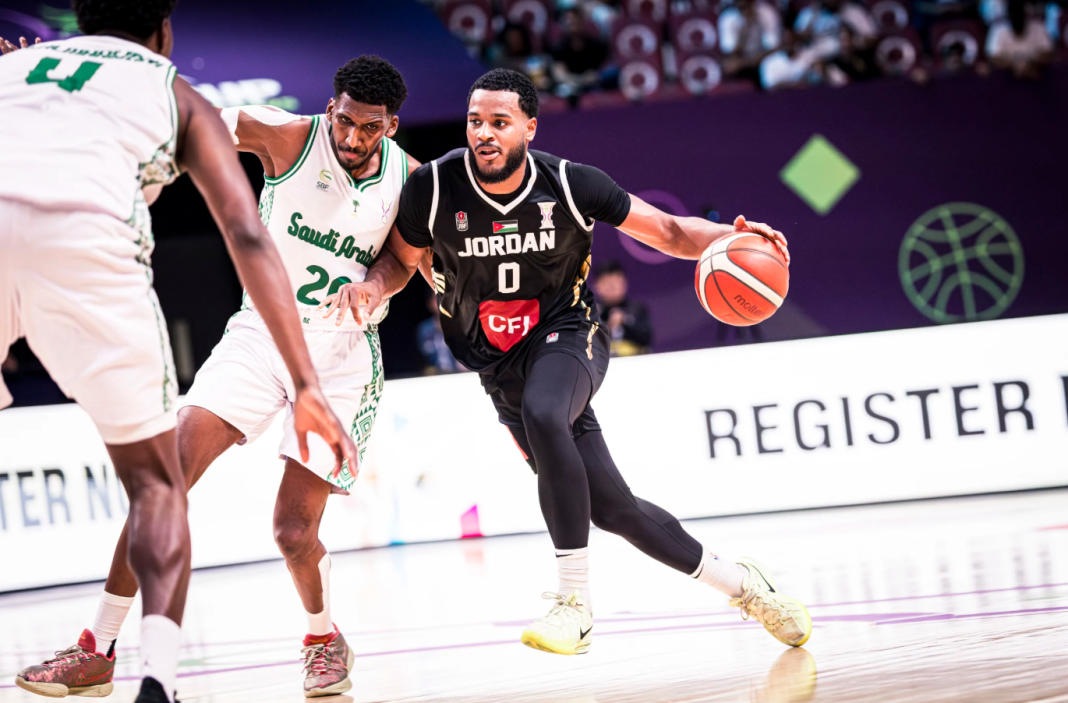

Older hoops fans will be seeing a familiar surname—Olajuwon—when Jordan lines up against Gilas Pilipinas in the fourth window of the FIBA World Cup Asian Qualifiers at the SM Mall of Asia (MOA) Arena on Friday.
That Olajuwon is Abdullah, and no, he doesn’t just share the surname of NBA legend Hakeem Olajuwon. He really is The Dream’s son. He isn’t a token player either just because he’s the son of hoops royalty. He genuinely is part of new coach Luis Guil’s system and will likely get meaningful minutes. But before delving into his potential role with the Falcons, it’s worth clarifying the more interesting question first: How did Abdullah wind up with Jordan given Hakeem’s Nigerian roots and American citizenship?
Why Abdullah Olajuwon Is a Local
Abdullah Olajuwon’s eligibility to play for Jordan comes down to something simpler than most people would guess: the young man was born there. He and his brother Abdulrahman were both born in Jordan, a country the Olajuwon family has genuine ties to as Hakeem has lived there at times for Islamic studies, his wife is Jordanian, and the family has kept those connections over the years.
Crucially, birth in Jordan generally confers Jordanian citizenship, and citizenship is the core requirement FIBA looks at for national team eligibility. Since neither brother had previously represented another country’s senior national team in official FIBA competition, there were no nationality‑switch waiting periods or restrictions to navigate either. They simply made their senior debuts for Jordan at last year’s FIBA Asia Cup—clean and straightforward.
It’s a genuinely different path than the one Hakeem himself took. He was born in Nigeria, became a U.S. citizen, and eventually played for the United States at the 1996 Olympics after receiving a FIBA exemption to do so.
Two generations, two entirely different routes to an international jersey. And for good measure, the family’s basketball ties don’t stop at Jordan—younger brothers Aziz and Malik were born in Canada and have represented Canada at the youth level, meaning the Olajuwon name is currently spread across three different national programs depending on which son and which passport you’re looking at.
The Player, Not Just the Name
On the court, Abdullah’s college career gave little hint of what was coming. In his lone season at the University of Detroit Mercy in 2023‑24, he averaged just 2.3 points, 2.8 rebounds, and 15.1 minutes. International basketball, though, has treated him rather better. He made his debut with Jordan at last year’s FIBA Asia Cup, putting up 9.0 points and 5.3 rebounds across four games. He has since featured in all six of Jordan’s games in the qualifiers, averaging 6.5 points, 3.8 rebounds, 2.5 assists, and 15.2 minutes. Most recently, he dropped 18 points against SGA in the Jones Cup.
Abdullah Olajuwon arrives in Manila as part of a Jordan roster mixing genuine experience with fresh faces. The veteran core—29‑year‑old Freddy Ibrahim, 36‑year‑old Mohamed Hussein Shahar, 33‑year‑old Ahmed Al Dwairi, 39‑year‑old Ahmad Alhamarsheh, and 32‑year‑old Amin Abu Hawwas—are all two‑time World Cup participants. Alongside Abdullah, the newer names include Hedi Alshami, UNLV center Faris Mucharbach, and Saif Saleh, all 20 years old. Alshami and Saleh have already made noise of their own, scoring 21 and 12 points, respectively, against SGA at the Jones Cup.
Olajuwon and the Falcons will take on Gilas Pilipinas on Friday, 6:30 p.m., at the MOA Arena.