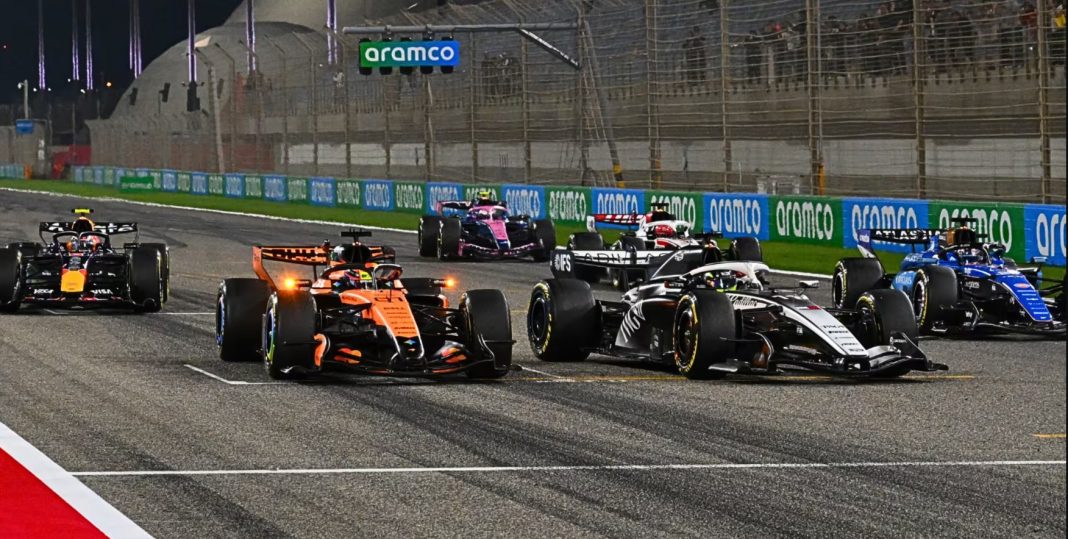

Formula 1 (F1) has always been about the edge—the edge of technology, the edge of physics, the edge of the driver’s steely nerves and sheer talent.
But as the paddock packs up from Bahrain preseason testing and turns its attention to the 2026 season opener in Melbourne, a serious question needs to be answered: Have the suits in Paris (a.k.a. the FIA) finally over-engineered this “edge” right out of the cockpit?
On paper, the new “Agile Car” concept was supposed to fix everything: smaller cars, lighter cars, machines that could dart through corners instead of muscling their way around like the heavy behemoths we’ve seen over the past decade.
Simple enough, right? Lighter means more responsive. Smaller means better racing lines.
None of this, though, is as simple as it seems.
The 50/50 Split: When Power Becomes a Puzzle
The centerpiece of the 2026 F1 regulations is the new 50/50 power split. That means half the car’s power now comes from the traditional internal combustion engine (the gasoline-powered part), and the other half comes from electric energy stored in a battery.
In raw numbers, the electric motor now produces 350kW of power, while the combustion engine has been reduced to 400kW. For context, a kilowatt (kW) is simply a unit of power—higher numbers mean more output.
On paper, this sounds progressive. F1 cars are cleaner and more efficient.
In practice? Drivers aren’t exactly calling it exhilarating.
To keep the battery charged, drivers are now forced to do things that look unnatural—like downshifting in high-speed corners just to regenerate energy. Downshifting, which normally means shifting to a lower gear for more acceleration or control, is now sometimes being used as a battery-charging tool instead of a racing one.
Max Verstappen’s comment calling it “Formula E on steroids” wasn’t just a joke. It was a signal.
And when Fernando Alonso—a driver who has competed in everything from screaming V10 engines to modern hybrid power units—says the driver’s role is “dying,” people listen.
If F1 becomes a contest of who can “lift and coast” most efficiently (lifting off the throttle early to save fuel and recharge energy), are we still watching the fastest drivers in the world? Or are we watching elite energy managers instead?
Performance Theatre or Pure Racing?
Then there’s the aerodynamic overhaul.
DRS—the Drag Reduction System that opens a flap in the rear wing to help with overtaking—is gone. In its place comes “Active Aero” and something called “Manual Override Mode.”
Active Aero means the car can physically change its aerodynamic setup depending on where it is on the track. In “Corner Mode” (Z-mode), the car increases downforce—essentially pressing the car harder into the track for more grip in turns. In “Straight Mode” (X-mode), it reduces drag, allowing the car to slice through the air faster on straightaways.
In theory, that sounds futuristic. Smarter cars, more adaptability.
But the controversy lies in how it’s applied.
The lead car in an F1 race will be forced to taper its power at 290 km/h, while the chasing car can deploy the full 350kW boost up to 337 km/h. In simple terms: the rulebook now builds in a speed advantage for the car behind. It’s a software-coded catch-up mechanism.
Yes, it could guarantee more overtakes. Yes, it might look great in highlight clips.
But overtaking in F1 has always carried weight because of the difficulty involved, from the braking point, to the timing, to the boldness it takes.
If the car ahead is effectively slowed by regulation, does the move still feel earned? And in a contest of fastest time wins, how does it makes sense to automatically slow down the car in the lead?
The 16:1 Loophole: Innovation or Exploitation?
There’s also technical intrigue in all this.
Reports suggest that Mercedes and Red Bull, the two standard bearers of F1 in recent years, may have found a way to work around the 16:1 compression ratio limit using thermal expansion tricks.
For clarity, compression ratio refers to how tightly the fuel-air mixture is compressed inside the engine before ignition. Higher compression can mean more efficiency and power, but it’s tightly regulated to keep things fair. Thermal expansion simply refers to materials expanding when heated. If exploited cleverly, it could alter engine behavior within the legal framework—but beyond the spirit of the rule.
This kind of high-level engineering chess match is classic Formula 1. It’s part of the sport’s DNA.
But heading into a brand-new era, optics matter. If teams are already filing protests before a race wheel has even turned, the “reset” the FIA promised begins to look fragile.
F1 Is a Sport at a Crossroads
The 2026 regulations were designed to unify the grid, to create closer racing, to inject excitement.
Instead, the FIA may have just created a car that is lighter in weight but heavier in complexity. The “Agile Car” may be physically smaller, but the regulatory shadow around it feels larger than ever.
As F1 heads to Australia, the biggest question isn’t just who built the fastest machine. It’s whether the sport has traded too much of its identity in pursuit of sustainability and spectacle.
For the fans, for the drivers themselves, and for the integrity of competition itself, that’s not just a technical adjustment. It’s a question of identity. It’s a reframing of age-old philosophy.