
The Concrete Ceiling: Physicality Meets Star Volatility
The 2026 Eastern Conference Finals have converged on a fascinating clash of styles that will test the very limits of postseason composure. In one corner stands the third-seeded New York Knicks, refreshed and menacing after dispatching their early playoff opponents with ruthless efficiency. In the other stands the fourth-seeded Cleveland Cavaliers, an emotionally charged, high-ceiling juggernaut fresh off an exhausting, cardiac-arresting Game 7 road triumph over the top-ranked Detroit Pistons. For the whole Rebanse Fam who for sure appreciates the heavy-contact, high-IQ chess match of late-May basketball, this matchup promises a spectacular war of attrition.
The contrast in recent mileage introduces an unpredictable variable into the opening games. New York has luxury resting on its side, having wrapped up their previous series back on May 10, giving their rotation a massive recovery window. Cleveland, meanwhile, enters the lion’s den with almost zero breathing room, having spent every ounce of their physical capital just days ago.
ECF Odds & The Harden Factor: Can Cleveland’s Trade Deadline Masterstroke Upset the Rested Knicks?
Despite the rest disparity, the desert sportsbooks are projecting a highly competitive battle. DraftKings Sportsbook opens the Eastern Conference Finals, establishing New York as a firm -265 series favorite, while the underdog Cavaliers offer a highly tempting +215 on the comeback line. For Game 1 under the legendary, world-famous ceiling of Madison Square Garden, oddsmakers have pinned the Knicks as a -6.5 point favorite, attaching an Over/Under total of 214.5 points. This gives Manhattan an implied 70.8% win probability to hold serve at home, though sharp tactical minds know Cleveland owns the exact specific layout needed to bust up the bracket.
The regular-season tapestry reveals that Cleveland holds the programmatic blueprints to disrupt the favorite. While New York claimed the overall season series 2-1, everything changed at the trade deadline when the Cavaliers pushed all their chips into the center to acquire James Harden. In their solitary face-off with Harden anchoring the Wine and Gold on February 24, Cleveland completely choked out the Knicks in a commanding 109-94 blowout. Harden orchestrated that night with pristine surgical precision, logging a stellar stat line of 20 points, 2 rebounds, and 4 assists while converting 4-of-7 from deep. That blowout proved that when Cleveland sets a disciplined half-court tempo, it can render New York’s defensive pressure obsolete.
Clash of the Twin Towers: Robinson’s Historic Glass-Cleaning vs. Cleveland’s Defensive Wall
The absolute epicenter of this series will be a monstrous, paint-bruising frontline war involving four of the most physically imposing bigs in the eastern hemisphere. Karl-Anthony Towns and Mitchell Robinson present a twin-headed monster of perimeter gravity and brutal interior glass-cleaning. Robinson has been an absolute industrial vacuum in the paint during this 2026 postseason, anchoring his team with an ungodly stat line of 11.0 PPG, 16.0 RPG, and 2.0 BPG, which includes a historic 8.0 offensive rebounds per night that gives New York an unmatched second-chance scoring infrastructure. Cleveland counters with their hyper-athletic defensive wall of Evan Mobley and Jarrett Allen. Allen has been a statistical leviathan this spring, putting up 19.0 PPG, 10.0 RPG, and 2.0 BPG while shooting a stellar 7-of-8 from the floor in their most recent clash. Mobley’s lateral versatility allows him to step out to the perimeter to smother Towns’ trailing triples, which dynamically frees up Allen to wage a hand-to-hand rebounding war against Robinson in the restricted area.
Second Unit Turf War: Jordan Clarkson’s Firepower vs. Cleveland’s Veteran Stability
When the primary engines take a breather, the non-starter minutes will showcase an intense turf war of bench depth. New York relies heavily on the backcourt scoring punch of Miles McBride and, of course, our very own Kabayan Jordan Clarkson to preserve floor spacing. Cleveland will look to counteract that bench firepower by leaning on the veteran, low-key stability of Dennis Schröder and Max Strus. Schröder’s ability to maintain offensive structure when Harden sits prevents the catastrophic offensive drop-offs that doom most underdogs, while Strus’s relentless activity will be crucial to match New York’s second unit.
Guard Supremacy & Series Verdict: Brunson’s Composure vs. The Mitchell-Harden Volatility
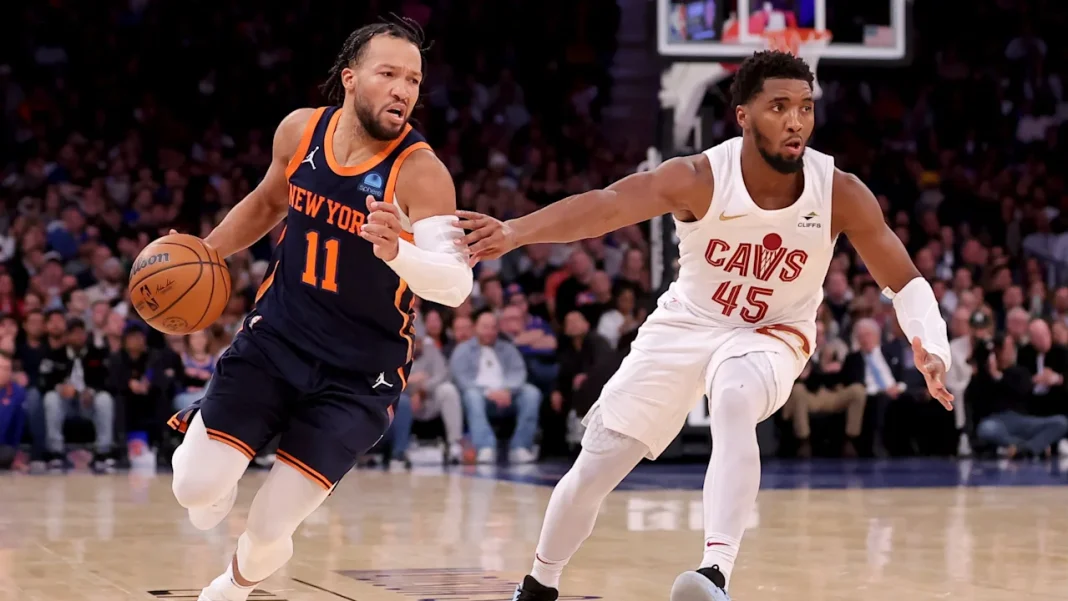
Ultimately, this entire series boils down to an elite, guard-driven showdown at the top of the key. Jalen Brunson has displayed a spectacular level of championship-caliber composure, leading the charge with a postseason line of 20.0 PPG, 4.0 APG, and 1.0 BPG while operating with a microscopic turnover rate. To challenge his mastery, the Cavaliers roll out a backcourt tandem of supreme offensive volatility in Donovan Mitchell and James Harden. Mitchell has been playing like an absolute possessed scoring engine, generating a playoff line of 23 points, 5 rebounds, and 4 assists while aggressively drawing contact to shoot an elite 11-of-14 from the charity stripe. If Harden embraces his secondary playmaker responsibilities and Mitchell avoids low-efficiency isolation traps, Cleveland can severely compromise New York’s perimeter containment.
The sideline chess match offers a brilliant evolution of modern philosophies. Head coach Mike Brown has completely transformed the Knicks this season, replacing old, rigid defensive isolation with a high-octane, fluid offense that values rapid pace and open-floor dialogue. Across the floor, Kenny Atkinson counters with a hyper-modern, space-oriented scheme designed to leverage Cleveland’s passing lanes. Brown will likely deploy a healthy OG Anunoby, who has completely moved past a minor mid-spring hamstring tweak, to act as a physical blanket on Mitchell. Atkinson must counter by utilizing Mobley as a high-post decision maker, using quick back-door cuts to exploit New York’s tendency to over-commit to ball handlers.
The acoustic environments will play a massive factor, as neither arena is built for the faint of heart. Madison Square Garden remains the ultimate colosseum of basketball pressure, where a deafening, hostile New York crowd can easily unravel an opponent’s offensive rhythm. Conversely, the Rocket Arena in Cleveland has turned into an absolute madhouse during this playoff run, fueling the Cavaliers to an impressive 5-2 home record through the opening rounds.
A deep dive into advanced tracking data reveals an underlying trend that tips the scales for Manhattan: the Knicks’ lethal perimeter accuracy under Mike Brown’s fast-paced system. New York currently paces the remaining playoff field with a blistering 40.8% team three-point percentage and an ungodly +19.8 Net Rating, converting simple drive and kick sequences into rapid, game-altering scoring runs before opposing interior shot blockers can reset their feet.
The 7-Game Verdict: Why New York’s Depth and Clutch Continuity Will Push the Knicks to the NBA Finals
When you synthesize the massive rest advantage, the elite perimeter accuracy, and Brunson’s unmatched clutch navigation, the conclusion becomes clear. The Cavaliers possess the defensive length and the star firepower to shatter the Knicks’ expectations, but New York’s offensive continuity and interior depth are simply too refined to break over a seven-game stretch. Expect a highly physical, low-efficiency war that will push both frontcourts to their absolute limits.
Verdict, I am a bit biased to support our Kabayan, so it’s gonna be the New York Knicks to secure the series 4-3 to finally go back and headline the NBA Finals. For what it’s worth, Cleveland really has the capability to upset the Knicks, but it’s their composure and consistency that is a bit questionable to trust.