
The PBA on Tuesday announced a new rule pertaining to the next PBA Drafts: starting in next year’s Season 51 PBA Draft, players with live contracts with other leagues will be barred from joining the pool of applicants. The rule ostensibly looks to avoid instances of players not being able to join the teams that drafted them because they still have to finish out their contracts.
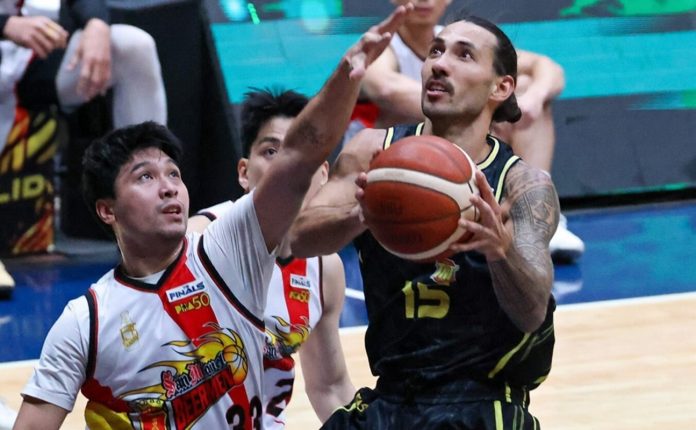
That’s exactly what happened to some notable picks in the Season 50 PBA Draft, with the debuts of first overall pick Geo Chiu, fifth overall pick Ljay Gonzales, and seventh overall pick Jason Brickman delayed because each had to finish out their contracts in the MPBL. Chiu and Brickman, in fact, haven’t seen action just yet, as their team, the Abra Weavers, made it all the way to the Finals.
In a vacuum, the rule makes absolute sense. It eliminates conflicts of interest and ensures that players don’t get into any legal trouble. More importantly, it preserves the true purpose of a draft: to infuse teams with fresh talent right away.
The PBA Doesn’t Exist in a Vacuum Anymore
Unfortunately for the PBA, it doesn’t exist in a vacuum anymore. It isn’t the only professional league for the country’s aspiring hoopers. There’s the aforementioned MPBL. There’s also the PSL. There are countless overseas leagues as well—the Japan B.League and the KBL come to mind—willing to dip into the Philippines’ talent pool in basketball.
This increase in competition has eaten away at the PBA’s normally large talent pool, so much so that most of the best young talent available is choosing to go international rather than local. This is why the PBA should be widening its talent funnel, though it appears it has instead chosen to narrow it—by choice, by policy, and by sheer shortsightedness.
Shrinking the Talent Pool Further
With its latest ruling barring draft applicants who still have live contracts in other leagues, the PBA has effectively shrunk its pool of potential draftees for Season 51—and maybe in upcoming drafts as well. The thing is, it didn’t have to.
Again, on paper, the logic sounds neat. No contracts elsewhere means teams get players who can suit up immediately. No waiting games. No contractual limbo. Clean and simple.
In reality, it is anything but.
This decision disproportionately affects players from the MPBL, as well as Filipinos playing abroad in leagues like the KBL and Japan’s B.League—leagues whose seasons and contract calendars do not conveniently align with the PBA draft timeline. The MPBL, for instance, usually runs until December, while the Japan B.League and KBL traditionally run from October to April or May. Many of these players will still be under contract by December, effectively disqualifying them from even entering the draft.
Take, for instance, Harold Alarcon and Gerry Abadiano, whom reports say have signed with the MPBL’s Go for Gold San Juan Knights for at least the next season, alongside two other UP Fighting Maroons in Terrence Fortea and Reyland Torres. Assuming they signed just a one-season deal but are still under contract with San Juan by December, they won’t be able to join the Season 51 PBA Draft anymore because of this new rule.
UAAP standouts who graduated after Season 88, like Michael Phillips, Nic Cabañero, Kymani Ladi, Dom Escobar, Ced Manzano, and Forthsky Padrigao, could be affected by this new rule, too, as it’s highly likely they’ll explore other leagues between now and the next PBA Draft, which is a year away. What happens then if, say, Manzano and Padrigao have active contracts by December in any league but want to join the draft anyway because that same contract will be ending in January, February, or March?
While this is purely speculation at this point, this ruling could result in fewer applicants, less competition, and a weaker draft class.
New PBA Draft Rule Is Ironic, to Say the Least
The irony is hard to miss. The PBA has long talked about elevating its level of play and remaining relevant in an increasingly globalized basketball landscape. Yet this ruling discourages exactly the kind of players who could help do that—battle-tested professionals who have thrived in other competitive environments.
Instead of adapting to the modern realities of player mobility and global leagues, the PBA has chosen to retreat inward, once again prioritizing convenience over growth.
If history is any indication, the league will feel the effects soon enough—when PBA Draft night nexy years arrives and the list of names feels noticeably thinner.
Yet again, a self-inflicted wound.