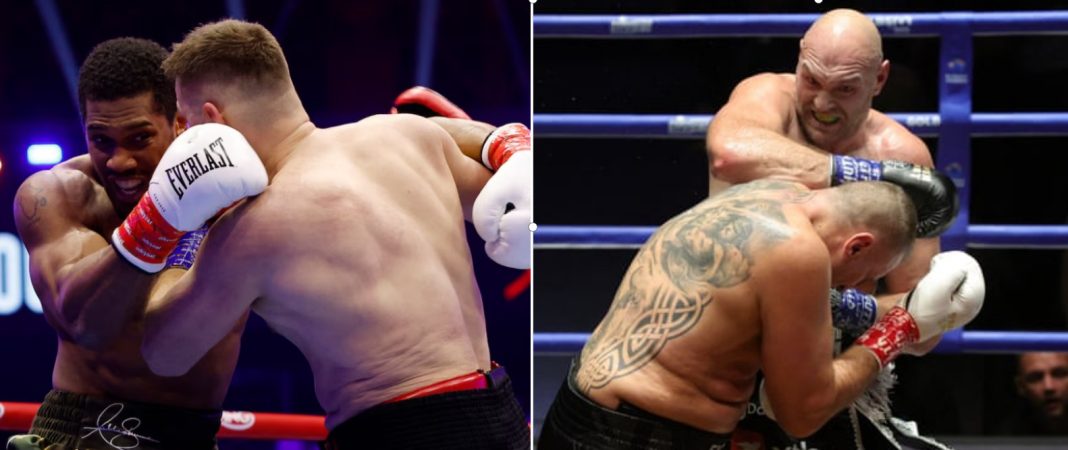

Tyson Fury stopped Mariusz Wach in Thailand on Saturday. Anthony Joshua survived two knockdowns to knock out Kristian Prenga in Saudi Arabia on Sunday. And the heavyweight super-fight that British boxing has been waiting years for is now, apparently, actually happening.
Both men have signed a deal with boxing powerbroker Turki Alalshikh for a November fight. No date, no venue, and no formal announcement have been made yet—but the machinery is in motion, and this weekend produced the results that were needed to keep it that way.
Fury Does the Work in Pattaya
Fury got the job done against Wach in front of around 1,500 people in Pattaya, Thailand—an unusually modest setting for a former world heavyweight champion, made stranger by the fact that Fury appeared second on the card rather than headlining it. None of that seemed to bother him. He wanted rounds. He got them.
Wach, 46, gave Fury a moment of pause in Round 2 with a shot that landed cleanly. Beyond that, it was one-way traffic. Fury cruised through six rounds before Wach’s corner pulled their man off his stool before the seventh could begin. Fury improved to 36-2-1 with 25 knockouts.
“I’ve had one fight in two years—this is my second fight in two years, of course I wanted to get the rounds in. I want to be active,” Fury said afterward. “It’s not just the boxing in the ring. It’s spilt over the fight week, the press conference, the weigh-in, the nerves. Everything.”
The fight, notably, was not televised—and proceeds from ticket sales went to the Father Ray Foundation, a Thai charity supporting underprivileged children. In between rounds of a tune-up bout in a holiday resort town, Fury found time for a charitable contribution. Only in boxing.
Joshua Fights Through Grief and Two Knockdowns
Joshua’s night in Saudi Arabia was considerably more dramatic—and more emotional.
Kristian Prenga landed a right hand and a right uppercut in the opening seconds of the fight that sent Joshua to the canvas. He got up, but looked unsteady. He went down a second time before the end of the first round. The crowd fell quiet. His promoter Eddie Hearn, watching from ringside, admitted later that he thought the comeback had come too soon.
But this is what Joshua does. He absorbs the worst and keeps going.
He settled in Round 2, found his jab, and began to pick Prenga apart with right hands. Two more significant rights dropped the challenger against the ropes. Prenga never recovered. The fight was stopped. Joshua won by second-round knockout and improved his record.
The moment carried weight far beyond boxing. Joshua was involved in a car crash just seven months ago that killed two of his close friends, Sina Ghami and Latif “Latz” Ayodele—whose names were honored on the ring canvas on Saturday night. Joshua fought back tears afterward.
A Fight That Could Arrive Years Too Late
Fury and Joshua have signed the deal. They have both won. November is the target. And yet—there is something bittersweet about watching Fury and Joshua finally edge toward each other.
This fight was supposed to happen years ago. Twice, actually—contracts were signed in 2021 for a two-fight deal that would have given British boxing its greatest modern rivalry on the biggest possible stage. Both times, the fight collapsed. Fury took a Deontay Wilder trilogy rematch. Joshua lost to Oleksandr Usyk—twice—and the world heavyweight titles moved elsewhere. By the time both men were back and available, the window had already shifted.
But make no mistake about it: Fury vs. Joshua is still a massive fight. Two former world heavyweight champions, both British, settling something that has been lingering for half a decade. But it arrives slightly diminished—not by lack of quality, but by the passage of time and the unavoidable reality that Usyk’s reign has made it a fight for pride and legacy rather than championships.
The fight is coming. It is just five years late.