
The match between the US and Belgium has not been played yet. The controversy is already the story.
FIFA handed the US a significant boost on Monday by suspending Folarin Balogun’s red card from the Bosnia-Herzegovina match, making the Monaco striker available for Tuesday’s round of 16 FIFA World Clash clash against Belgium in Seattle. The decision sent shockwaves through the tournament—and left Belgium furious, Norway bemused, and football’s governing body defending an unprecedented ruling that its own competition regulations appear to contradict.
The Decision That Stunned Everyone
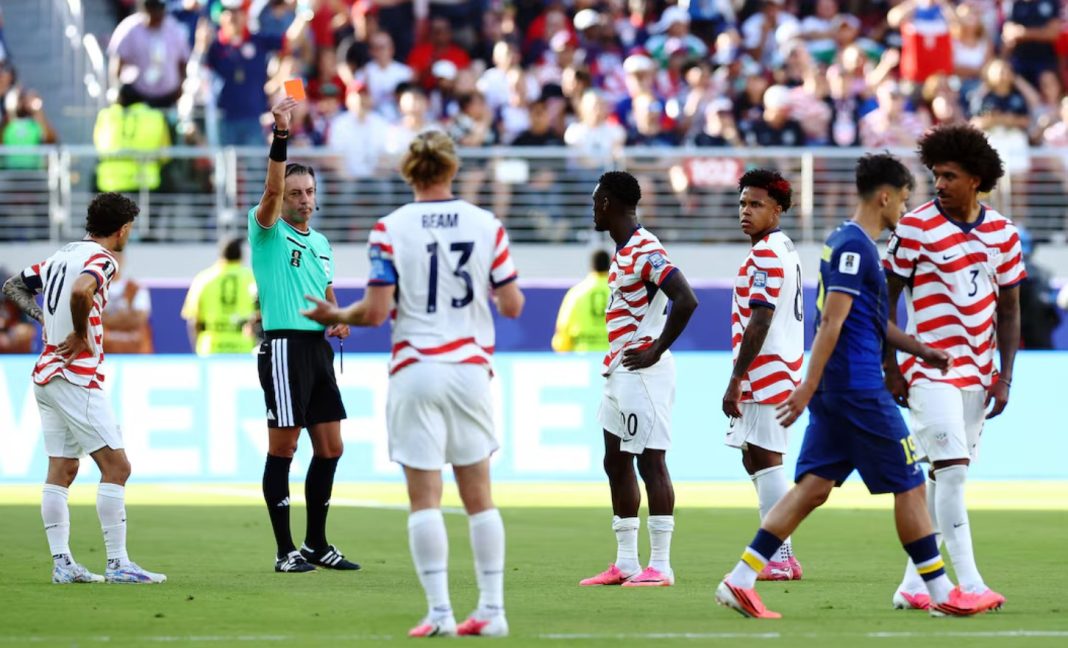
Balogun scored the opener in the USA’s 2-0 round of 32 win over Bosnia-Herzegovina, then was sent off in the 64th minute for a challenge on Tarik Muharemovic that was waved through on the field before VAR intervened and produced a red card. An automatic one-game ban followed—standard procedure, applied consistently throughout the tournament for every red card issued.
Until now.
On Monday, FIFA announced it had invoked Article 27 of its disciplinary code to suspend the implementation of Balogun’s ban, placing the striker on a one-year probationary period instead. The decision came after ABC confirmed that President Donald Trump had personally called FIFA president Gianni Infantino following the Bosnia game, asking for the ruling to be reviewed.
“By operation of Article 27 FDC, the implementation of the automatic match suspension for USA player Folarin Balogun is suspended for a probationary period of one year,” FIFA said in a statement.
Trump celebrated on social media shortly after the announcement. “Thank you to FIFA for doing what was right, and reversing a great injustice!” he posted.
The US men’s national team players found out the way everyone else did. “I think a lot of us thought it was AI at first,” defender Chris Richards said. “We weren’t sure if it was true or not.”
Belgium’s Fury—And Their Point
Belgium were not amused. They were not close to amused.
Coach Rudi Garcia delivered one of the tournament’s most pointed press conference lines when he was asked to respond to the news. “I didn’t know that at the World Cup, the 5th of July is actually the first of April—it’s April Fools’ Day,” he said drily.
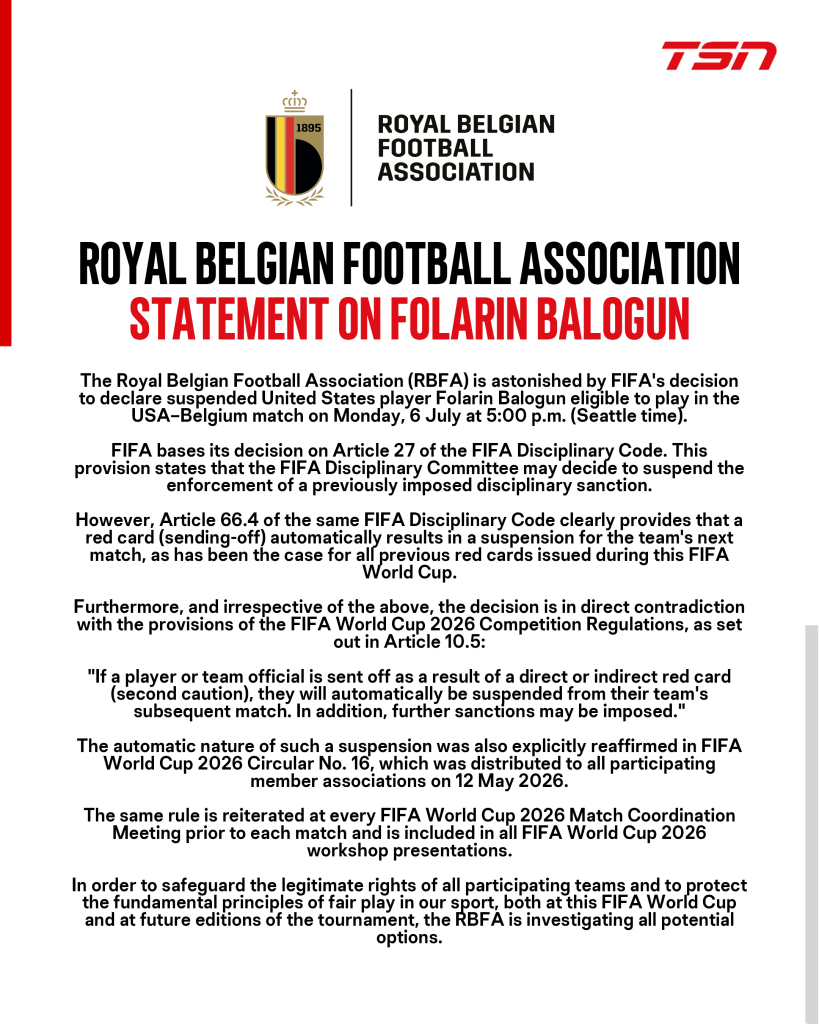
The Belgian federation went further in a formal statement, calling the decision “astonishing” and describing it as being “in direct contradiction” to the rules FIFA itself had established before the tournament began. Article 10.5 of the FIFA World Cup 2026 Competition Regulations states clearly that any player sent off via direct or indirect red card is automatically suspended for their team’s next match. No exceptions. No discretionary review mechanisms mentioned.
The federation announced it was investigating all potential options, though Garcia later suggested the priority was the match rather than legal avenues. “We want to focus on sporting matters,” he said.
He was also at pains to clarify that Belgium’s objection was not merely self-interested. “We’re not defending the national team or federation,” Garcia said. “We are defending football.”
That distinction matters. FIFA’s precedent here goes beyond Monday’s game—it raises the question of what a red card means in a tournament context if the governing body can retroactively commute the punishment at its discretion.
Norway Weighs In
Belgium were not alone in their criticism. Norway coach Stale Solbakken, fresh from his side’s stunning defeat of Brazil in the round of 16 on Monday, was asked about the Balogun situation and did not hold back.
“I think that’s a big mistake by FIFA; it’s not a great conclusion,” Solbakken said. “He has got a red card, VAR concluded it was a red card, and he was sent off, so that means he is suspended for one game.”
He went further, identifying the reputational risk that now hangs over the result regardless of which side wins. “What happens if he scores a goal that wins the game? What happens with the next red card? Will there be a committee somewhere to take the red card away? It’s a bad, bad, bad, bad decision for the World Cup, and I feel sorry for the U.S. because if they win, the result will always be looked at in that way.”
It is a fair point—and an uncomfortable one. However Monday’s match ends, the asterisk is already attached.
Pochettino and Belgium Keep Their Focus
US coach Mauricio Pochettino was careful to distance himself from the political dimension of the decision, saying he was not involved in the process and had spent the week focused entirely on preparation for Belgium.
“No, we cannot mix that,” he said, when asked whether politicians should be lobbying FIFA over match decisions. “It is a decision from FIFA with the evidence that happened before.”
He framed the broader principle—the ability to revisit decisions when VAR evidence is deemed inconclusive—as a positive development for the sport. Whether the rest of the world sees it that way will depend heavily on how Monday night unfolds.
Belgium goalkeeper Thibaut Courtois, for his part, kept the focus narrow and professional.
“Had it been done earlier, we’d have been able to be mentally more prepared, perhaps,” Courtois said. “But we’ll be ready. We’ll be on the pitch. They have 11 players, not only Balogun.”
He assessed the striker pragmatically. “He is a very fast striker. Maybe a different profile than Pepi. They have a lot of quality up front.”
Tuesday’s round-of-16 match between the US and Belgium kicks off tomorrow in Seattle. And Balogun will play for the home team.
Expect fireworks.