

Former professional basketball player and World Trade Center (WTC) Greater Philadelphia President and CEO Thomas Young delivered a message during a recent business forum that resonated well beyond sports: success after the game depends on how early, and how seriously, athletes prepare for life beyond it.
Drawing from his experience playing professionally in Germany and leading collegiate teams in the United States, Young emphasized that while time on the court is finite, the mindset that drives athletic excellence must carry forward into business.
“Basketball taught me more than any classroom ever did,” Young reflected. “It taught me how to lose with dignity and win with humility. It taught me to think strategically in real time, read situations quickly, and trust the people around you.”
An All-American standout at Indiana University of Pennsylvania, Young played professionally in Hamburg, Germany before making a conscious choice at age 24 to pivot toward government relations, public service and executive leadership.
For Young, the transition from sports to business is not reinvention, but continuation. The qualities developed through competition, including discipline, preparation, teamwork, resilience, and accountability, translate directly into entrepreneurship and executive leadership.
“Understanding the concept of team is one of the biggest lessons sports taught me,” he added. “Everyone has a role to play in reaching the ultimate goal, and you have to trust the people around you to do their jobs for the betterment of the team. That is just as important in business as it is in basketball. You also learn discipline, accountability and how to adjust when things don’t go according to plan.”
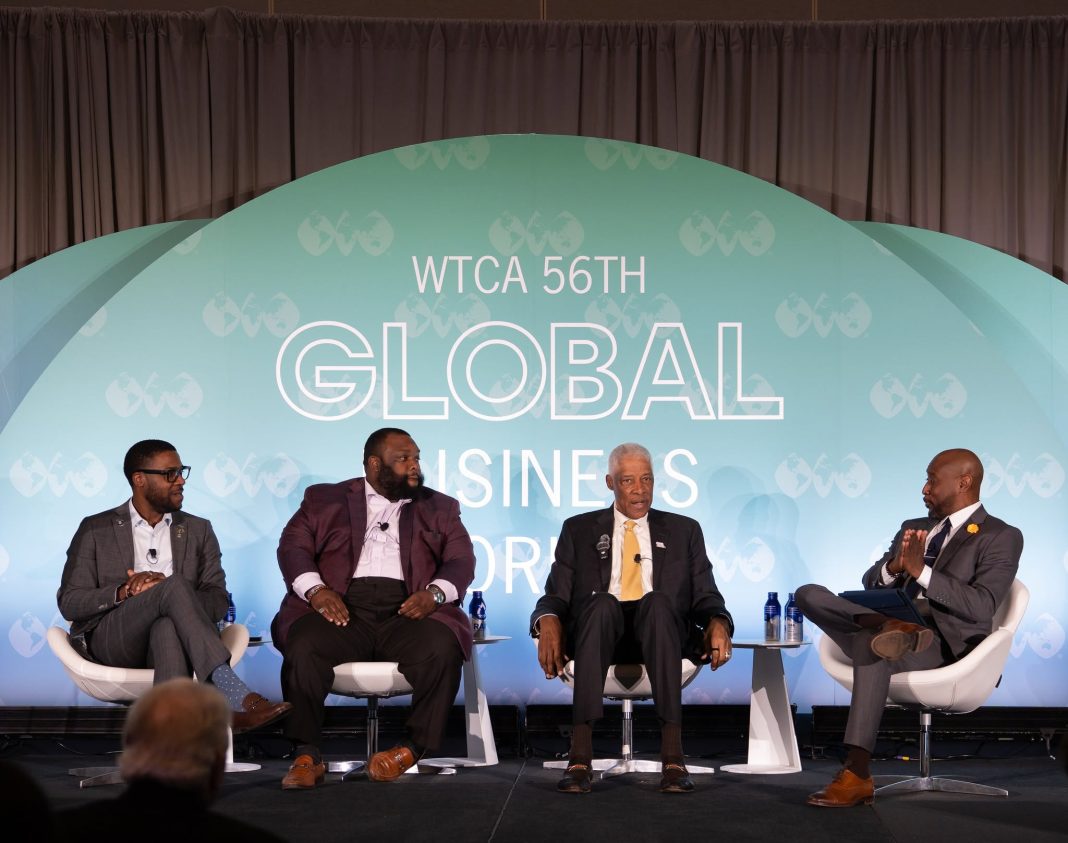
His remarks, delivered on the sidelines of the 56th annual World Trade Centers Association (WTCA) Global Business Forum (GBF), hosted by WTC Greater Philadelphia in Philadelphia, Pennsylvania (April 19-22), also struck a chord with global basketball communities, particularly in the Philippines.
Recognizing the country’s deep passion for the sport and the influence of the Philippine Basketball Association (PBA), Young encouraged Filipino players to look beyond their playing careers and begin shaping their next chapter early through business, leadership, and community engagement.
“The PBA being the oldest professional basketball league in Asia speaks to the history and importance of the game in the Philippines. My message to Filipino players building their post-career business portfolios is to remain open and flexible. Whether you’re on the basketball court or in the boardroom, never be afraid to try a new role or learn a different way of doing things. The role you played as an athlete does not have to define what you can become after the game,” said Young.
For Filipino athletes, Young’s message reflects both opportunity and caution. According to prominent Philippine sports journalist Quinito Henson, post-career paths among PBA players vary widely, ranging from success in business and public service to financial hardship.
He cites examples such as Kerby Raymundo, now a businessman; Vergel Meneses, currently mayor of Bulakan, Bulacan; and Robert Jaworski, who transitioned into business and national politics. Others, like Benjie Paras and Alvin Patrimonio, built careers in entertainment and team management, respectively.
But not all transitions are smooth. “Making wise investments while living off a handsome contract as a player is critical for a secure future,” Henson said, warning that lavish spending and poor financial decisions can leave athletes vulnerable after retirement.
He added that the same traits highlighted by Young, such as discipline, focus, teamwork, and integrity, are essential in business. “Succeeding in business is never a one-man show,” Henson said. “It entails building partnerships, setting goals, and maintaining high standards of work ethics.”
Henson regards athletes who successfully carry their court values beyond the game as vital models of professionalism and humility for the next generation.
The message aligns with the broader spirit of the recent WTCA GBF, which brought together leaders across industries to exchange ideas that endure. Young’s insights, reinforced by local experience, underscore a universal truth: the transition from athlete to entrepreneur is not an endpoint, but an evolution best approached with preparation, discipline, and purpose.
World Trade Centers Association (WTCA) and WTC Greater Philadelphia hosted the 2026 WTCA GBF in April in Philadelphia, Pennsylvania, marking the Forum’s return to the United States for the first time in nearly a decade. The annual WTCA GBF convenes WTCA members and their global networks, bringing together leaders from business, government, academia and international organizations.
Following the conference, one of the GBF panelists, basketball legend Julius “Dr. J” Erving, stated “I have great respect for the love of basketball in the Philippines, it is one of the great basketball cultures in the world. It’s especially meaningful to see that passion recognized on a global level, with the Philippines helping lead the effort to establish World Basketball Day (December 21) at the United Nations in 2023.”
Philippine companies and members of the World Trade Center Metro Manila (WTCMM) Business Club also participated in the event to expand their markets and build cross-border partnerships through WTCA’s global platform.
For Alexis S. San Luis II, President of Golden Resources and Ecomaterials Enterprises Inc. (GREEN Inc.), the GBF experience reinforced a fundamental principle: global opportunities are built on relationships and trust. “We were able to build strong connections and generate serious leads. it reinforced the importance of being present and ready for the global market,” he said.