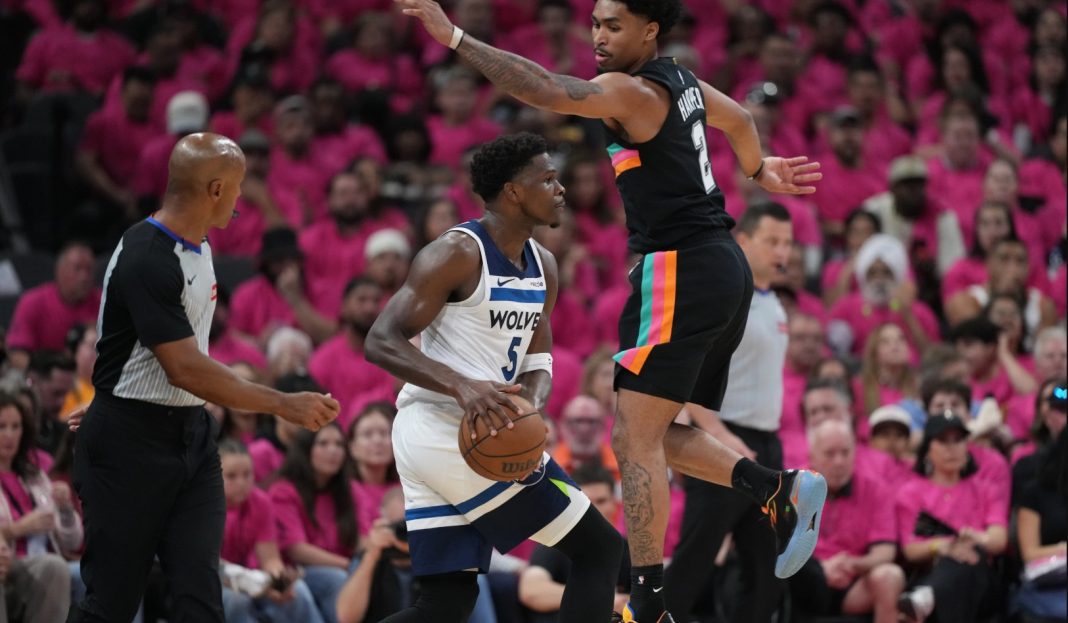


Nobody expected Anthony Edwards to play. He played anyway—and the Minnesota Timberwolves needed every bit of it.
Edwards returned from a bone bruise and hyperextended left knee suffered just ten days ago in Game 4 against the Denver Nuggets to score 18 points—11 of them in the fourth quarter—as the Timberwolves held on to beat the San Antonio Spurs 104-102 in Game 1 of the Western Conference semifinals on Tuesday. It was only San Antonio’s second loss in its last 17 series openers at home.
Game 2 is Thursday in San Antonio.
The Anthony Edwards Return Nobody Saw Coming
Anthony Edwards was expected to miss at least the first two games of this series. He entered the game with 6:53 remaining in the first quarter, the Timberwolves trailing 11-8, and finished 8-for-13 in 25 minutes. After draining a stepback three-pointer early in the game, he turned toward the Spurs bench and screamed: “I’m back! I’m back!”
He definitely was.
Edwards did not need to be perfect. His presence alone changed the equation for Minnesota, which was also without Donte DiVincenzo (torn right Achilles tendon) and Ayo Dosunmu (right calf soreness). Having their best player available—even at limited capacity—settled the entire team.
“Nobody expected him to play,” said Timberwolves veteran Mike Conley. “It was just his level of commitment to the game. Not just to the game, but to his teammates. It showed a lot.”
Anthony Edwards was equally direct about what he knew his return meant. “I know for a fact, just me being out there, it calms everybody down,” he said. “It takes pressure off of everybody just knowing that I’m out there, I’m available to play. And just doing what I do best, just trying to put the ball in the hoop.”
Julius Randle led the Timberwolves with 21 points and 10 rebounds. The supporting cast did enough. But the story of this game starts and ends with the player who was not supposed to be there.
Wembanyama’s Historic Night Was Not Enough
Victor Wembanyama put together one of the most statistically remarkable defensive performances in NBA postseason history—and still ended up on the losing side.
The NBA Defensive Player of the Year recorded 11 points, 15 rebounds, and 12 blocks—making him only the third player to record a triple-double in the playoffs using the blocks category since the league began tracking them in 1973-74. He opened the game by blocking two consecutive driving layups from Terrence Shannon Jr. on back-to-back possessions, then blocked Rudy Gobert’s layup two minutes later. He finished the first half alone with seven blocks.
Twelve blocks. The number is almost absurd. And yet the Spurs still lost.
The reason is simple: Wembanyama shot 5-for-17 from the field. Elite defensive performance and elite offensive efficiency have to coexist in a series opener. On Tuesday, only one of those things happened.
Dylan Harper scored 18 points for San Antonio, with Julian Champagnie and Stephon Castle each adding 17. The Spurs had their chances. Devin Vassell stole the ball and Harper converted a layup with 31 seconds remaining to cut the deficit to 104-102. After Randle missed for Minnesota, Champagnie got a look at a three-pointer at the buzzer that would have won it.
It did not fall.
“We have to be better,” Wembanyama said after the game. “It shows up on the stat sheet. We need to figure out before 48 hours what we can do better and I’ve got no doubt that we will. I trust us.”
What Game 1 Actually Showed
Minnesota won this game without two key rotation players, with their best player operating at limited capacity, against one of the most disruptive defensive forces in the sport. That is a significant result. Edwards showing up at all—let alone delivering 11 fourth-quarter points—is the kind of development that reshapes a series before it has properly begun.
San Antonio played well enough to win and came up two points short. Wembanyama will not shoot 5-for-17 again. The Spurs will be better in Game 2.
But so will Anthony Edwards.