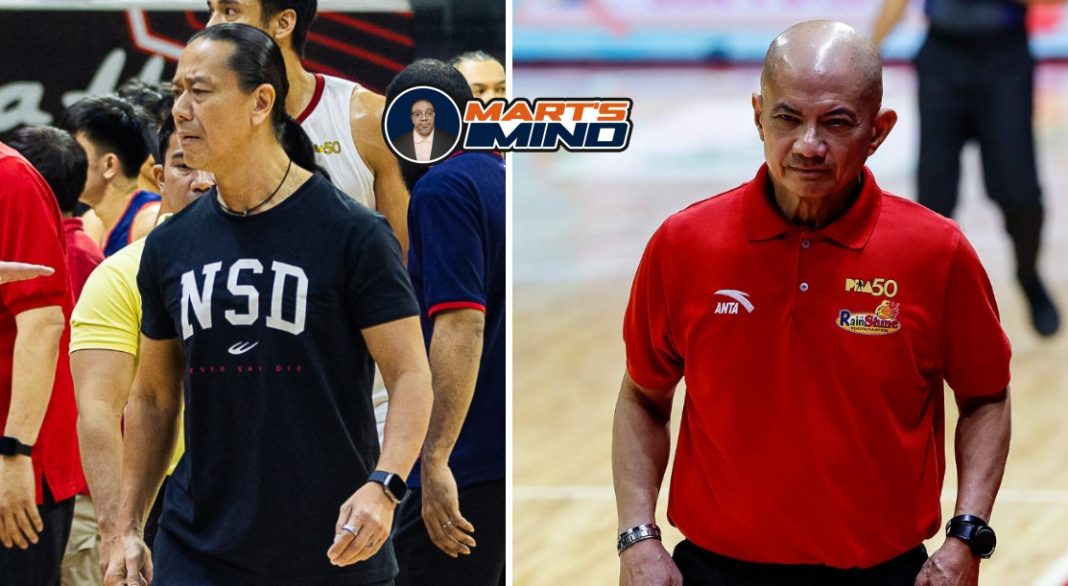

The Rain or Shine Elasto Painters and Barangay Ginebra San Miguel are playing what’s turning out to be a classic series in the PBA Commissioner’s Cup semis. So, it is quite unfortunate that a verbal spat between Rain or Shine coach Yeng Guiao and Ginebra team governor Alfrancis Chua seems to have overshadowed the great basketball the two teams are playing.
What Happened Between Guiao and Chua?
By now you know what happened. Chua and Guiao exchanged words in the first quarter of Game 4, with the latter calling out the former for incessantly talking to the referees. The two weren’t done, though, as Chua confronted Guiao at the customary postgame handshake between teams after Rain or Shine hacked out a series-tying win.
Afterward, it was clear Guiao had had enough, doubling down on Chua’s behavior while seated at Ginebra’s bench. The fiery tactician characteristically did not mince words, comparing Chua’s courtside conduct unfavorably to that of longtime Rain or Shine governor Atty. Mert Mondragon while also invoking the question of demeanor and ethics.
The Overriding Issue
Guiao’s concern is specific: Chua, as a governor sitting on the bench, has been vocal and aggressive in his interactions with referees—not once, not twice, but across multiple games in a row.
“I feel as a governor, it’s not his job to keep talking to the referees in such an intimidating way. Never ginawa ‘yun ni Atty. Mert,” Guiao said, the contrast with Mondragon’s restrained style clearly on his mind. “Ang layo ng behavior.”
He acknowledged that emotion is part of the game. That is reasonable. Coaches lose their composure sometimes. Players get heated. Even governors, who are human beings watching something they care deeply about, can get caught up in the moment.
“Tao rin naman ‘yang mga ‘yan, minsan may bugso ng emosyon,” Guiao said. “Pero, you cannot do that for Game 1, Game 2, Game 3, Game 4.”
That last line is the crux of it. A single outburst is a moment of weakness. Four straight games of the same behavior is a pattern. And patterns require a response from the league—not just a public rebuke from a rival coach.
Why Guiao Is Right—and Why His Point Matters
The PBA has a long and complicated history with the relationship between team ownership, management, and on‑court conduct. Governors sitting on the bench is not unusual in this league. What is unusual—or what should be unusual—is a governor using that proximity to the court to apply pressure on officials in a way that no coach or player would be permitted to do without consequence.
Suffice to say, Chua sitting on Ginebra’s bench isn’t wrong per se. However, it becomes problematic when he uses that spot to start talking to game officials, sometimes even standing up and approaching the referees to give them a piece of his mind.
Referees are not perfect. No officiating body in any sport is. But the moment team governors begin treating them as subordinates to be managed, berated, or intimidated, you have a problem that goes beyond one playoff series. You have a precedent—and in Philippine basketball, precedents have a way of calcifying into accepted norms faster than anyone would like.
Guiao put it plainly: “I feel in terms of demeanor and ethics, ‘yung board, kung kaya nila pigilan ‘yung emotions nila, they should just leave that to their coaching staff and to the players, kung gusto mag‑reklamo ng players.”
That is not a radical position. That is basic professional conduct. Coaches have designated channels for questioning calls. Players have their moments. Governors should not be operating outside that structure simply because they have the money, the power, and the seat at the table.
“Maybe sometimes baka paminsan‑minsan madala siya ng emosyon, but not every time,” Guiao added.
Of course, it bears mentioning that Guiao himself is no angel. He berates referees and swears at them. He hurls profanities that could penetrate even men with hearts of stone. He has even gotten into it with players and fellow coaches. He directs invectives even at his own players. So, no, he has no moral ascendancy whatsoever.
But when it comes to Chua sitting on that Ginebra bench and making himself heard repeatedly, Guiao is definitely in the right.
What the PBA Needs to Do
Guiao raising the issue publicly is useful. It puts the behavior on record and frames it as something worth discussing. But public criticism from a rival coach, however accurate, does not change behavior on its own. What changes behavior is institutional accountability.
The PBA Board of Governors—of which Chua is a member—might not be the right body to levy sanctions on one of its own. That conflict of interest is real, and it is exactly why the commissioner’s office needs to take the lead here.
In particular, the league, through Commissioner Willie Marcial, should clarify, formally and publicly, what conduct is acceptable from governors seated on the bench during games. But it can’t be just a verbal reminder nor a quiet conversation in the hallway. It should be in the form of a written standard with consequences attached—consequences that apply regardless of the franchise involved or the playoff stakes in play.
Or, in the interest of fairness and propriety, Marcial can outright ban team governors from sitting at the bench.
Then again, we all know Marcial isn’t doing any of that any time soon. And it’s probably not because he doesn’t have the balls for it. It’s likely more because his hands are tied, and his actions—and lofty position for that matter—are inevitably tied to the dictates of Chua and the other governors. In other words, Marcial can’t do anything unless he has the board’s support and go‑signal. In short, Marcial has only the title here, not the influence. And certainly not the power. Ricky Vargas, the PBA Chairman and team governor of the TNT Tropang 5G has that power. So do the other team governors, from Archen Cayabyab of the Converge FiberXers, to Siliman Sy of the Blackwater Bossing, to Emilio Tiu of the Titan Ultra Giant Risers.
However, history suggests that Chua’s board brethren won’t be calling out one of their own, much less move to discipline him in any way, shape, or form.
Actions Matter
But, again, Guiao is right that Chua’s behavior is a problem. Similarly, the PBA is right to let coaches manage their teams on the floor. And the league is right that governors have a role in the organization.
What is wrong is allowing the lines between those roles to blur in ways that compromise the integrity of officiating and the credibility of the league itself. Doing nothing about it because the person doing it happens to sit on the board is just downright wrong. It’s also terrible optics for a league trying to restore its once‑respected reputation.
Yeng Guiao called it out. Now the PBA needs to act on it.