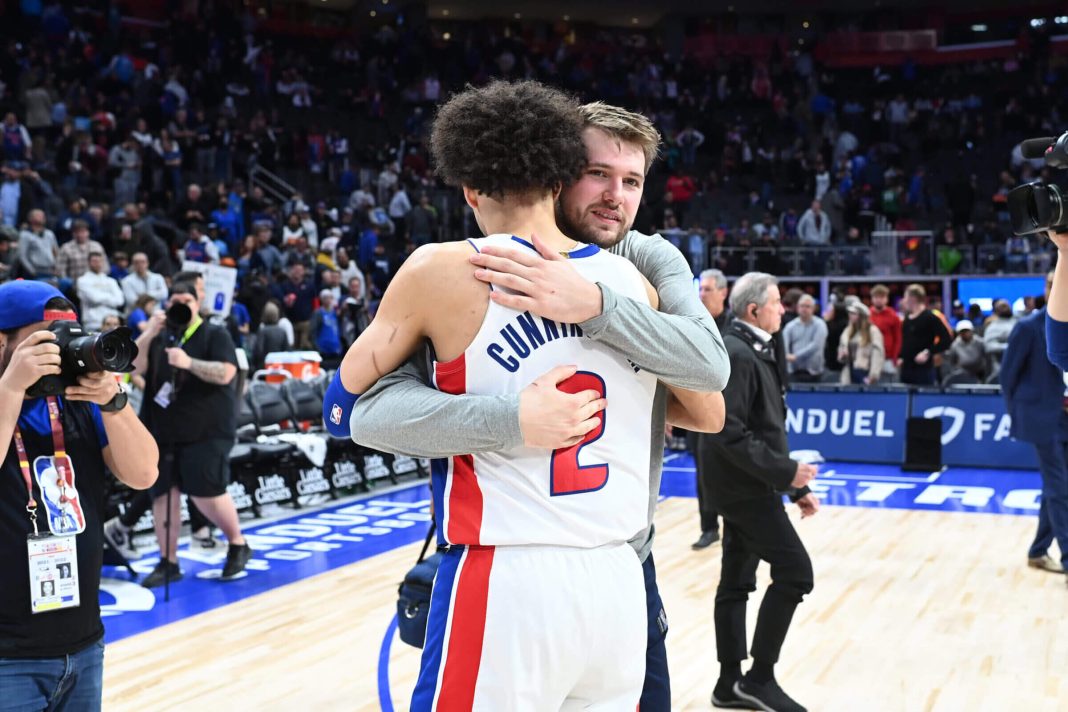

The NBA and the National Basketball Players Association (NBPA) reached an agreement on Thursday (Friday, Philippine time) that Luka Doncic and Cade Cunningham will both be eligible for end-of-season awards despite falling short of the league’s 65-game threshold. Anthony Edwards, who also fell short, went through the formal arbitration process—and was denied.
The outcomes are fair to debate. The inconsistency is hard to ignore.
The Luka Doncic Case
Doncic played 64 games this season—one short of the minimum. The two games he missed in December were for travel to be present for the birth of his daughter abroad.
The NBA and NBPA agreed, without going to arbitration, that the circumstances qualified as extraordinary. The league’s collective bargaining agreement includes a clause allowing players who fall short of 65 games to petition for awards eligibility, citing extraordinary circumstances.
Doncic was grateful—and characteristically measured about it.
“It was so important to me to be present for the birth of my daughter in December, and I appreciate Mark, Jeanie, Rob, JJ, and the entire Lakers organization for fully supporting me and allowing me to travel to be there,” Doncic posted on X. “This season has been so special to me because of what my teammates and I have been able to accomplish, and I am honored to have the opportunity to be considered for the league’s end-of-season awards.”
The Cade Cunningham Case
Cunningham played 63 games. He missed 12 after suffering a collapsed lung in mid-March—an injury sustained on the court.
Like Doncic, his case was resolved without arbitration, with the NBA and NBPA jointly agreeing that the totality of his circumstances qualified him for the exemption.
The Anthony Edwards Case
Edwards played 60 games and missed time due to an infection—an illness, not a choice and not a rest decision. His case went to arbitration. The arbitrator denied it.
The reaction from Edwards’ camp was pointed. His business manager Justin Holland did not hide his frustration.
“For me personally, I’m a bit confused at the clemency for Cade who missed time for something that happened on the court, and not Ant, who missed time for an infection, but ultimately you already know Ant isn’t trippin over it AT ALL,” Holland said in a statement to ESPN.
Timberwolves coach Chris Finch was less restrained.
“I’m not sure why we have a rule if we have an appeal process that is overturned in two-thirds of the cases that were held before,” Finch said. “Feels more like a suggestion than a rule.”
It is a fair point. When a rule is selectively enforced—with outcomes varying based on which cases go to arbitration and which are handled bilaterally between the league and union—it stops functioning as a rule and starts functioning as a negotiation. Edwards missed games due to illness. Cunningham missed games due to injury. The distinction between the two, in terms of a player’s control over the situation, is not obvious.
The Bigger Problem With the 65-Game Rule
Edwards is not alone in being left out. Giannis Antetokounmpo, Stephen Curry, LeBron James, and Devin Booker are all ineligible for end-of-season awards this season for failing to reach 65 games. Victor Wembanyama only reached the threshold in the penultimate game of the season. Nikola Jokic made it on the final day.
Denver Nuggets coach David Adelman put the absurdity of that last scenario plainly. “That’s not the spirit of what that rule is,” he said, arguing that a player like Jokic—who never wants to come out of the game—should not be one game away from award ineligibility.
NBA Commissioner Adam Silver, however, has been consistent in defending the rule. “I think it is working,” Silver said at last month’s board of governors press conference in New York. He pointed to the period before the rule’s implementation, when almost a third of All-NBA players had not played 80% of their games. “That was a huge issue for the league.”
The rule exists for a legitimate reason. Load management was genuinely becoming a problem, and giving it teeth was a necessary corrective. But the execution—where two players get bilateral exemptions without arbitration while a third goes through the formal process and gets denied—creates the impression of a system that applies standards unevenly depending on the case.
Edwards is not trippin. His coach, and a lot of people watching, might be seeing a different story.